8 Best BrowserStack Alternatives in 2026 (Prices Verified)
✓ Written by a human: a real person verified every number on this page against the vendor's own pricing page and signs off on every update. AI helps with the drafting. How we compare.
BrowserStack works. But the pricing is per parallel session, so the moment your team runs tests concurrently, the bill multiplies. And SSO, SIM-enabled devices, and on-prem device labs all sit behind Team Pro or Enterprise tiers. Below are eight platforms worth a look: AI-first challengers, budget device clouds, and enterprise stalwarts, with features, pricing, and trade-offs side by side. Plus one bonus pick for teams happy to run their own browsers.
How we compared
Every price, tier limit, and feature on this page comes straight from the vendor's public pricing page, pulled in July 2026. Nothing is quoted from memory or from third-party roundups. Where a vendor publishes no pricing (Perfecto), we say so and link out rather than guess. Star ratings weigh feature depth, entry-tier value, and how much is locked behind enterprise plans. Prices are in US dollars, except TestingBot, which bills in euros. Spotted something outdated? Tell us.
Quick comparison
| Overall rating (features, UX) | ⭐⭐⭐⭐⭐ | ⭐⭐⭐⭐ | ⭐⭐⭐⭐ | ⭐⭐⭐ | ⭐⭐⭐ | ⭐⭐⭐ | ⭐⭐ | ⭐⭐ |
| Core Testing | ||||||||
| Desktop cross-browser testing | ✓ | ✓ | ✓ | ✕ | ✓ | ✓ | ✓ | ✓ |
| Real mobile devices | ✓ | ✓ | ✓ | ✓ | ✓ | ✓ | ✓ | ✕ |
| Automation (Selenium, Appium & co.) | ✓ | ✓ | ✓ | ✓ | ✓ | ✕ | ✓ | ✕ |
| Published device/browser count | — | 10,000+ | 1,000s | — | 6,100+ | — | — | — |
| AI Testing | ||||||||
| AI test generation (plain English) | ✓ | ✕ | ✕ | ✕ | ✕ | ✕ | ✓ | ✕ |
| AI features included in base price | ✓ | ✕ | ✕ | ✕ | ✕ | ✕ | ✕ | ✕ |
| Self-healing tests | ✓ | ✕ | ✕ | ✕ | ✕ | ✕ | ✕ | ✕ |
| Deployment & Data Control | ||||||||
| On-premise / private-cloud option | ✓ | ✕ | ✕ | ✓ | ✕ | ✓ | ✕ | ✕ |
| Dedicated (non-shared) devices on entry plan | ✓ | ✕ | ✕ | ✕ | ✕ | ✕ | ✕ | ✕ |
| Virtual USB (cloud device as local) | ✓ | ✕ | ✕ | ✕ | ✕ | ✕ | ✕ | ✕ |
| Published compliance certs | SOC 2, ISO 27001 | — | SOC 2, ISO 27001 | — | — | — | — | — |
| Pricing & Access | ||||||||
| Published pricing (no sales call) | ✓ | ✓ | ✓ | ✓ | ✓ | ✓ | ✕ | ✓ |
| Free tier | ✕ | ✓ | ✕ | ✕ | ✕ | ✕ | ✕ | ✕ |








Here is our shortlist:
- TestGrid: best for teams that want AI test generation included and on-prem control
- TestMu AI (formerly LambdaTest): cheapest full cloud grid, from $15/month
- Sauce Labs: unlimited users and minutes on every plan
- Kobiton: mobile-first real-device testing
- TestingBot: budget pick with unlimited automation from €90/month
- HeadSpin: unusual device coverage: set-top boxes, smart TVs, POS
- Perfecto: quote-based enterprise platform from Perforce
- Browserling: quick live browser checks from $9/month
- Playwright (bonus): free, open-source, run it yourself
How to choose a BrowserStack alternative
Five things decide the fit before price does:
- Framework support. If your suite is Selenium, Appium, Cypress, or Playwright, the grid has to run it without rewrites.
- Device coverage. Real phones and legacy browser versions, not just the latest Chrome. The published counts are in the table above.
- Deployment model. Public cloud works for most teams; regulated ones need dedicated devices or an on-premise option.
- Pricing model. Per parallel session, per seat, or per device minute. Each one punishes a different usage pattern.
- Compliance. If procurement will ask for SOC 2 or ISO 27001, shortlist the vendors that publish them.
It also helps to know which layer of the stack you're replacing. Most "alternatives" roundups mix three different product types together:
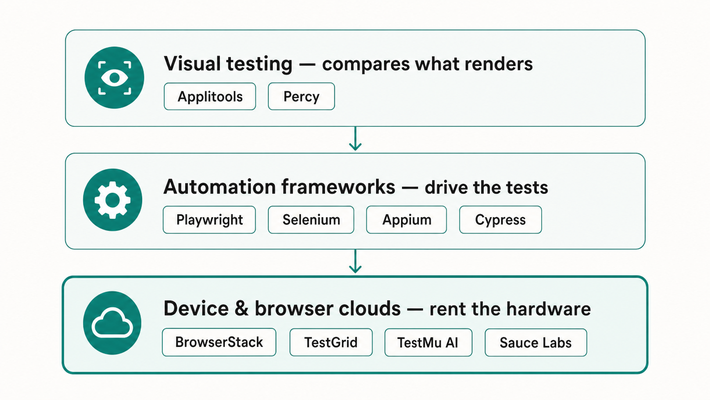
Device clouds (BrowserStack, TestGrid, TestMu AI, Sauce Labs) rent you the browsers and phones. Automation frameworks (Playwright, Selenium, Appium) drive the tests and run either on your machines or on a cloud. Visual testing tools (Applitools, Percy) compare screenshots for regressions and sit on top of either. Everything in our table is an infrastructure pick; Playwright, the bonus, is a framework you can run for free.
TestGrid
TestGrid is built for teams that want more from a device cloud than rented browser minutes. Every plan runs on dedicated infrastructure (your devices and browsers aren't shared with thousands of other accounts), and the full agentic AI platform ships with every package instead of being sold agent-by-agent. Users rate it 4.7/5 on G2.
What makes TestGrid a great BrowserStack alternative?
Two things most device clouds save for Enterprise, TestGrid turns on from the start: AI-powered test creation (write test cases in plain English, get runnable Selenium or Appium Java out that you can download and keep, so there's no lock-in) and deployment control. If your security team won't let app builds leave the building, the Custom Device Lab puts the whole platform on-premise or in your private cloud, with data residency and full audit logs. TestGrid is SOC 2 Type II and ISO/IEC 27001:2022 certified, and it runs your existing Selenium, Appium, Cypress, and Playwright suites without rewrites.
Top TestGrid features
- AI test case generation with 27+ testing agents included in the base price, with no per-agent fees.
- AgentRx self-healing plus AI bug summaries and reporting, on every plan.
- Real devices and real browsers on dedicated, non-shared infrastructure.
- Visual, API, page-performance, and geolocation testing bundled in.
- On-premise or private-cloud Device Lab with Virtual USB, MDM support, and audit logs.
- Runs existing Selenium, Appium, Cypress, Playwright, Espresso, and XCUITest suites.
- SOC 2 Type II and ISO/IEC 27001:2022 certified; customer data never trains AI models.
TestGrid cons
- No self-serve free trial. Evaluation runs as a guided one-to-two-week proof of concept.
- Entry price ($199/seat/month) is higher than per-session entry plans elsewhere on this list.
- AI test creation on Starter is metered by tokens (5,000/month); unlimited tokens require the Growth package.
Pricing
Trial: guided proof of concept (1–2 weeks) rather than self-serve
Billing: monthly per seat
Starter Package $199 / seat / month (4 devices/browsers, 5,000 AI tokens)
Growth Package: custom. Unlimited tokens, no execution limits, SSO (SAML/OAuth), VPN
Custom Device Lab (on-prem or hosted): contact sales
Start a TestGrid proof of concept Prices verified July 2026
TestMu AI (formerly LambdaTest)
TestMu AI is LambdaTest under a new name, and it's still the price leader among the big cloud grids: 3,000+ virtual browsers and 10,000+ real devices, with live testing from $15/month. On G2, where it's still listed as LambdaTest, it rates 4.4/5 with one of the biggest review counts in the category.
Where TestMu AI beats BrowserStack on price
Feature-for-feature it tracks BrowserStack closely (live testing, automation grid, visual regression) at consistently lower sticker prices, and it's one of the few with a real free tier. HyperExecute, its accelerated execution environment, is the standout for teams whose CI bottleneck is grid time. If you're weighing the two AI-era platforms directly, here's a TestGrid vs LambdaTest comparison.
Top TestMu AI features
- Live testing on 3,000+ virtual browsers from $15/month; real devices from $39/month.
- HyperExecute: faster test orchestration with unlimited minutes, from $103/month.
- KaneAI agent for plain-English test authoring (separate product, from $199/agent/month).
- Free tier: limited 2-minute live sessions plus 100 lifetime automation minutes.
- SmartUI visual regression with 2,000 free screenshots.
TestMu AI cons
- The product catalogue is sprawling: Live, Automation, HyperExecute, KaneAI, SmartUI, and Test Manager are all priced separately.
- AI test authoring is not included in grid plans; KaneAI starts at $199/agent/month.
- SSO and IP whitelisting sit on the custom Enterprise tier.
Pricing
Trial: free tier (no card)
Billing: annual (monthly at a premium)
Live: Virtual $15 / month; Real Device Plus $39 / month
Automation: $29–$199 / parallel session / month
KaneAI: from $199 / agent / month
Enterprise: custom
Sauce Labs
Sauce Labs is the longest-running name in cloud testing, now part of Tricentis. Its pricing quirk is the one to notice: every plan includes unlimited users and unlimited testing minutes. You pay per parallel session, not per person. G2 reviewers rate it 4.3/5 across 178 reviews.
Why teams switch from BrowserStack to Sauce Labs
For a large team doing moderate testing, unlimited users changes the maths completely: $39/month covers live testing for everyone in the org, where BrowserStack's team plans start at $150/month for five users. Enterprise adds SSO, a private device cloud, and the Sauce AI agents. Migrating an existing suite? See how it stacks up in this TestGrid vs Sauce Labs comparison.
Top Sauce Labs features
- Unlimited users and unlimited testing minutes on every plan.
- Live testing $39/month; virtual device cloud $149/month; real device cloud $199/month.
- Thousands of real iOS and Android devices plus emulators and simulators.
- Enterprise tier with SSO, private device cloud, IPSec proxy, and unified analytics.
Sauce Labs cons
- Each plan includes just 1 parallel test, and concurrency is where costs climb.
- AI features, SSO, and visual testing are Enterprise-only.
- No on-premise option; the private device cloud is hosted by Sauce.
Pricing
Trial: free trial available
Billing: annual and monthly
Live Testing $39 / month (annual; $49 monthly)
Virtual Device Cloud $149 / month (annual; $199 monthly)
Real Device Cloud $199 / month (annual; $249 monthly)
Enterprise: custom
Kobiton
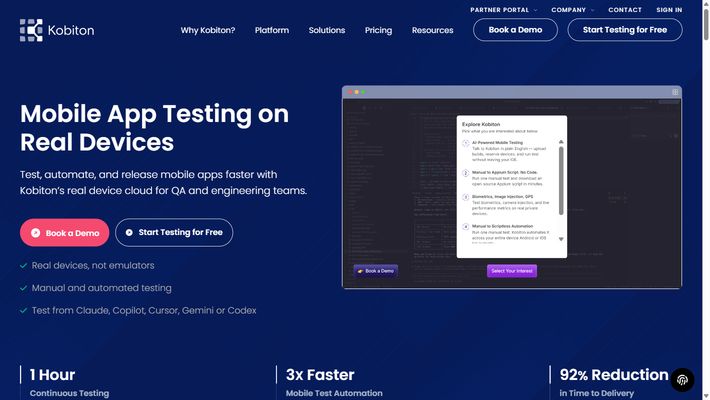
Kobiton is the mobile specialist. If your testing problem is "our app has to work on real phones and tablets" rather than "our website has to work in every browser", Kobiton's whole product is aimed at you. It rates 4.3/5 on G2.
What makes Kobiton a great BrowserStack alternative?
Manual and scripted testing on real devices is on every plan, priced by device minutes rather than parallel sessions. The Enterprise plan is where it gets interesting for regulated teams: dedicated and on-premise devices, AI-driven and no-code test generation, self-healing Appium scripts, and unlimited users.
Top Kobiton features
- Real-device manual and scripted automation testing on all plans.
- Minute-based pricing: Startup covers 500 device minutes for $83/month.
- Enterprise: dedicated/on-prem devices, unlimited Appium script generation, self-healing.
- Visual, accessibility, and performance validations on Enterprise.
Kobiton cons
- No desktop browser grid. This is a mobile platform, not a cross-browser one.
- The best features (AI, no-code, on-prem) all need the Enterprise plan.
- Minute packs run out fast with heavy automation; Scale is $9,000/year.
Pricing
Trial: free trial on self-serve plans
Billing: monthly; Scale is annual-only
Startup from $83 / month (500 minutes)
Accelerate from $399 / month (3,000 minutes)
Scale $9,000 / year (7,500 minutes/month)
Enterprise: custom (10+ users, on-prem, AI)
TestingBot
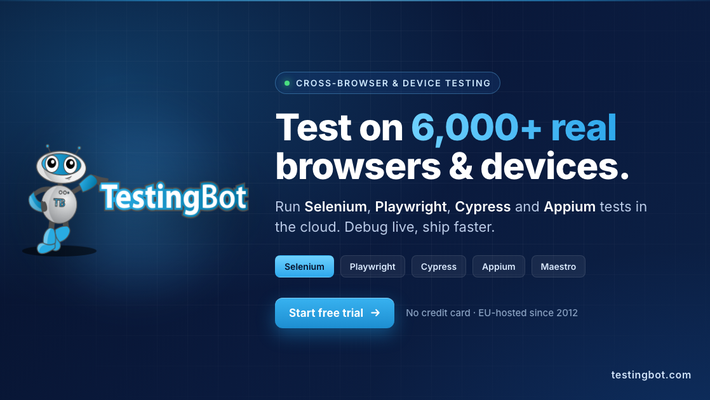
TestingBot is the value pick: a 6,100+ browser and device grid run by a small team since 2012, at prices that undercut every big-name competitor here. Its G2 footprint is tiny (a handful of reviews), which fits a small shop that spends on infrastructure rather than marketing.
Where TestingBot undercuts BrowserStack
Unlimited manual testing costs €20/month. Unlimited automated testing costs €90/month. Compare that with BrowserStack's $225/month Desktop & Mobile Pro at one parallel test. There's also true pay-as-you-go (€60 per 1,000 minutes, never expires), which nobody else on this list offers, and the 14-day trial needs no credit card.
Top TestingBot features
- 6,100+ real browsers and devices.
- Unlimited live and visual testing on every plan.
- Unlimited automation from €90/month (Automated Pro).
- Pay-as-you-go minutes that never expire.
- 24x7 support on all plans.
TestingBot cons
- No AI test generation or self-healing.
- SSO and enterprise security need the custom Enterprise plan (10+ parallel tests).
- Smaller device inventory than TestMu AI or Sauce Labs for the newest phone models.
Pricing
Trial: 14-day free trial (no credit card)
Billing: annual and monthly; pay-as-you-go from €60 per 1,000 minutes
Live €20 / month (annual; €30 monthly)
Automated €50 / month (1,000 minutes)
Automated Pro €90 / month (unlimited)
Enterprise: custom
HeadSpin
HeadSpin comes at testing from the performance side: its CloudTest platform pairs device access with performance analytics, and its device coverage extends past phones into set-top boxes, smart TVs, POS terminals, and speakers. Reviewers rate it 4.7/5 on G2.
What makes HeadSpin a great BrowserStack alternative?
CloudTest Go is the sleeper deal: $83/month (billed annually) with unlimited users and unlimited hours. And if your app ships on OTT boxes or smart TVs (device categories BrowserStack doesn't touch), HeadSpin is one of the few clouds that has them racked and ready. CloudTest Pro adds private, on-premise, or fully air-gapped deployment.
Top HeadSpin features
- Device coverage beyond mobile: set-top boxes, smart TVs, POS, speakers (Pro).
- CloudTest Go: unlimited users and hours for $83/month (annual).
- Performance and media analytics add-ons (biometric testing, regression intelligence).
- Private, on-premise, or air-gapped deployment on CloudTest Pro.
HeadSpin cons
- Automation isn't in the base Lite/Go plans. It's a paid add-on, and Lite is manual-only.
- Advanced capabilities are consistently add-on priced, so the real monthly cost is higher than the sticker.
- No published free trial.
Pricing
Trial: none published; direct signup on Lite and Go
Billing: monthly and annual
CloudTest Lite $39 / month (annual; $49 monthly; 1 user, 40 hrs)
CloudTest Go $83 / month (annual; $100 monthly; unlimited users and hours)
CloudTest Pro: custom (on-prem / air-gapped)
Perfecto
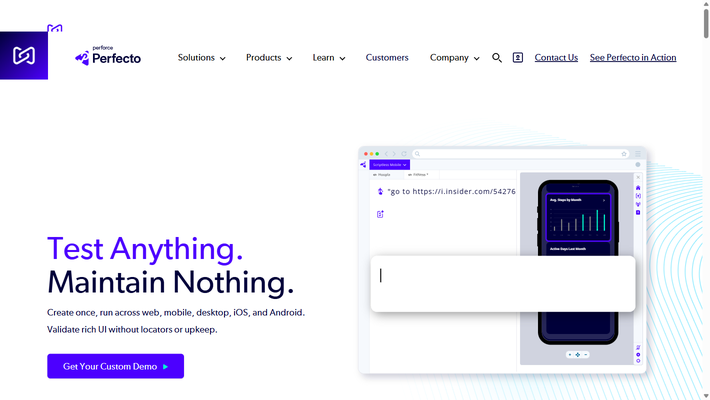
Perfecto, by Perforce, targets enterprises testing across web, mobile, and desktop from one platform, with an AI-driven scriptless approach. "No scripts, no frameworks, no maintenance" is the pitch. It rates 4.4/5 on G2 across 95 reviews, though some reviewers flag slow sessions.
What makes Perfecto a great BrowserStack alternative?
Every quote includes unlimited users and unlimited testing minutes, which suits big organisations that hate seat-counting. The scriptless AI testing angle means one test can run across platforms without framework upkeep. It's a considered, sales-led purchase rather than a swipe-your-card one.
Top Perfecto features
- Web, mobile, and desktop testing on one platform.
- Unlimited users and testing minutes on all quotes.
- AI-driven scriptless test creation and maintenance.
- Backed by Perforce's enterprise support organisation.
Perfecto cons
- No published pricing at all. Every purchase starts with a quote form and a sales call.
- No self-serve signup or free tier.
- Overkill for small teams that just need a browser grid.
Pricing
Quote-based only. All quotes include unlimited users and testing minutes; build your quote on their site.
Browserling
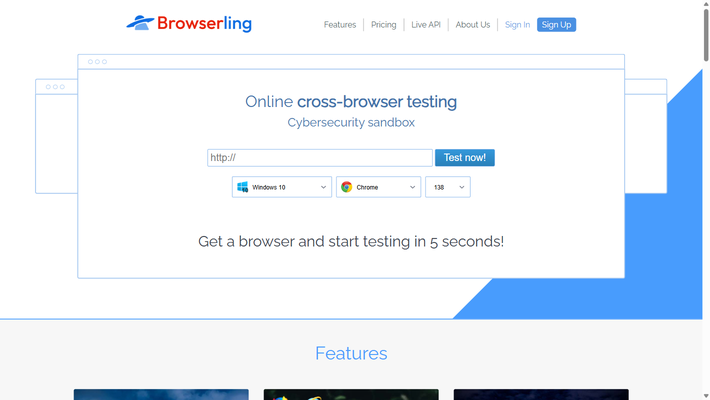
Browserling does one thing: live, interactive sessions in real browsers running on their servers. No automation grid, no device farm, just "does my site break in this browser?" answered in seconds.
When Browserling is all the BrowserStack alternative you need
If most of your BrowserStack usage is a developer poking at a bug in one browser, $9/month covers that. Higher tiers reach surprisingly far for the price: every Windows version back to XP, all Android versions, geo-browsing through 50+ countries, Tor nodes, and even BIOS-level access on Developer Pro.
Top Browserling features
- Live interactive testing in real browsers, up to 4K resolution.
- Legacy coverage: Windows XP through 11, all Android versions.
- Geo-browsing with datacenter, residential, and mobile IPs.
- SSH tunnels for testing localhost and staging environments.
Browserling cons
- No test automation, live sessions only.
- No real mobile device farm; it's a browser tool, not a device cloud.
- macOS and native Safari need the Developer Pro plan ($29/month).
Pricing
Trial: 30-day money-back guarantee
Billing: monthly and annual (annual discounts)
Starter $9 / month (annual)
Developer $19 / month
Developer Pro $29 / month
Team plans $19–$59 / user / month
Bonus: Playwright
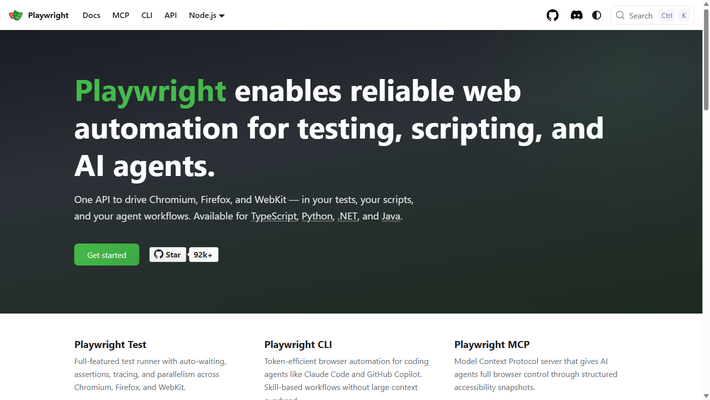
Playwright doesn't appear in our comparison table because it isn't a device cloud. It's an open-source automation framework you run on your own machines. But for plenty of teams, that's exactly the point.
Why Playwright replaces BrowserStack for engine-only testing
It bundles Chromium, Firefox, and WebKit engines under an Apache 2.0 license with no usage meter. If your cross-browser needs stop at "the three engines" and you don't need real physical devices, Playwright in your own CI replaces a grid subscription entirely, at $0.
Top Playwright features
- Chromium, Firefox, and WebKit engines bundled, free forever.
- Auto-waiting, tracing, and a first-class test runner.
- Runs in any CI; parallelism limited only by your own hardware.
- Several clouds on this list (including TestGrid) execute Playwright suites when you do need real devices.
Playwright cons
- Browser engines, not real browsers: no true Safari-on-iPhone or Samsung Internet coverage.
- No real mobile devices, and no live manual testing product.
- You own the infrastructure: scaling, flake management, and maintenance are your job.
Pricing
Free and open source (Apache 2.0). Your only costs are your own compute.
Frequently asked questions
Is there a free BrowserStack alternative?
Playwright is completely free: it's an Apache 2.0 licensed automation framework that bundles Chromium, Firefox, and WebKit, with no usage meter. Among the cloud grids, TestMu AI (formerly LambdaTest) has a genuine free tier with limited 2-minute live sessions and 100 lifetime automation minutes. TestingBot offers a 14-day free trial with no credit card, and Sauce Labs and Kobiton offer free trials on their self-serve plans.
What's the best BrowserStack alternative for enterprise teams?
TestGrid is built for this: dedicated (non-shared) device infrastructure on every plan, an on-premise or private-cloud Device Lab option, SOC 2 Type II and ISO/IEC 27001:2022 certification, and all of its AI testing agents included in the base price rather than sold as add-ons. Kobiton (Enterprise) and HeadSpin (CloudTest Pro) also offer on-premise device deployments, but both keep them for their top custom-priced tiers.
BrowserStack vs LambdaTest: which should I pick?
LambdaTest rebranded to TestMu AI, and it remains the budget pick: live testing on virtual browsers starts at $15/month versus BrowserStack's $29/month desktop plan, and real-device live testing is $39/month. BrowserStack still has the more polished ecosystem and larger enterprise footprint. If price per parallel session is the deciding factor, TestMu AI wins; note that its AI test authoring (KaneAI) is a separate product from $199/agent/month.
Can I run my existing Selenium or Appium tests on a BrowserStack alternative?
Yes. TestGrid, TestMu AI, Sauce Labs, and TestingBot all run existing Selenium and Appium suites with no rewrites, and TestGrid also executes Cypress, Playwright, Espresso, and XCUITest tests on its infrastructure. This is the most common migration path: point your existing suite at the new grid's endpoint, update credentials, and compare results before switching over.
Why is BrowserStack so expensive for teams?
BrowserStack prices automation per parallel test: Automate plans run $59 to $225 per month for a single parallel session, so a team running 5 parallel sessions multiplies that cost. Team plans for live testing start at $150/month, and features like SSO, IP whitelisting, and SIM-enabled devices sit on Team Pro, Team Ultimate, or Enterprise tiers. Alternatives compete mainly on this: Sauce Labs includes unlimited users on every plan, TestingBot sells unlimited automation from €90/month, and TestGrid prices per seat with its AI platform included.
Which BrowserStack alternative supports on-premise testing?
TestGrid's Custom Device Lab deploys the full platform on-premise or in your private cloud, with your devices, data residency controls, and full audit logs. Kobiton supports dedicated and on-premise devices on its Enterprise plan, and HeadSpin's CloudTest Pro offers private, on-premise, or air-gapped deployment. BrowserStack itself only offers a Custom Device Lab as a paid enterprise add-on.
What's the best BrowserStack alternative for you?
Match the tool to your actual bottleneck:
| Your bottleneck | Pick |
|---|---|
| AI test generation included, deployment control | TestGrid |
| Lowest sticker price on a full cloud grid | TestMu AI |
| Big team, modest test volume (unlimited users) | Sauce Labs |
| Mobile apps on real phones | Kobiton |
| Unlimited automation on a budget | TestingBot |
| Smart TVs, set-top boxes, POS devices | HeadSpin |
| Sales-led enterprise procurement | Perfecto |
| Quick manual browser checks | Browserling |
| Browser engines only, at $0 | Playwright |
Our overall pick is TestGrid: dedicated infrastructure, all AI agents, and an on-prem option are on from the start, not saved for Enterprise.
See how TestGrid compares Prices on this page verified July 2026
Most of these offer trials or free tiers. Running your flakiest test suite on two of them for a week will tell you more than any comparison table.
Sources & update history
All pricing and feature data on this page was accessed from these vendor pages on 10–11 July 2026:
- TestGrid pricing
- TestMu AI pricing
- Sauce Labs pricing
- Kobiton pricing
- TestingBot pricing
- HeadSpin pricing
- Perfecto pricing
- Browserling pricing
- Playwright documentation
- BrowserStack pricing (for the comparisons above)
- G2 review pages for each tool (ratings accessed 11 July 2026)
- Sauce Labs Trust Center (compliance certifications)
Update history: 10 July 2026: first published. 11 July 2026: pricing re-verified; author, sourcing, selection guide, G2 ratings, and decision table added.